Saturday, May 30, 2009

The toboggan and the boyscout salute.

Flying TobogganWinter in Maine is a fun time for a kid. Mountains of snow abound and endless adventure awaits. As a boy of only 7 years, young George Keegan couldn't wait to join the mayhem on the streets in their little town of Van Buren. With fifteen (15) foot snow drifts encroaching on the streets, the children of Van Buren set to work building snow forts and the world's most dangerous toboggan run.

Beatrice keegan was busily cleaning the kitchen and chasing the her younger boys, Tommy and Danny, when George announced he was going out to play. "Be careful", she scolded, and began to inspect his wintry uniform. She buttoned up his coat and gave him a big warm hug and whispered in his ear "I love you". She quickly shooed him out the door and turned her attention back to Tommy and Danny.

The snow drift covered the front of the house and swirled onto the roof of their quaint Victorian home. The previous day, young George and his brother Danny had tunneled their way out the front door in an arduous journey to street. They searched perilously for the mail-box as if they were explorers with Admiral Perry hunting for the North Pole. This struggle became an annual pilgrimage for George, Danny and Tommy Keegan.

Snow Tunnel

The toboggan run was nearly complete and young George Keegan volunteered to be the first test pilot. His mates pushed the sled as he started down main street and headed for the first curve. Only then did he realize the gravity of his situation. The children built an Olympic quality toboggan run and Keegan was just an aspiring amateur. He felt like the fastest human alive as he approached the first curve. Snowflakes flew past his head. Suddenly, time slowed and all sound seemed silenced as the daring young Lafayette Escadrille breached the first turn. Keegan's sled shot straight over the top of the snow bank. For the first time in his life he was truly airborne.

After what seemed like an eternity, young George found his sled rapidly approaching the snow and ice of another snow drift. He knew this was going to hurt. When he put his right arm out to brace for impact, he felt his thumb break, twice.

Stoically, Keegan pulled himself and the sled out of the snow drift just in time for the rest of the Escadrille to come cheering across the snow he'd just flown over. They hoisted him onto their shoulders and carried him back like a celebrate fighter ace.

One thing about young George Keegan was forever changed. From that day forward, he was never able to do a proper Boy Scout salute. A salute he demonstrated throughout his life whenever he told this story.


-GK3

[image credits:Flying Toboggan source]
[image credits: Snow Tunnel source]

Thursday, May 7, 2009

Messages in the Mist...

Aurora BorealisOne evening, when only a girl of twelve (12), young Beatrice Martin sat in the living room with her mother and father huddled around the family radio. The evening air was unusually alive with electricity and northern lights in the sky. It was early April, 1912, in New Brunswick, Canada and the family was listening to live stories and music on their mahogany radio.

As the night drew on, their evening's entertainment came to a close and went off the air however, no one turned off the radio right away. While Beatrice was looking out the window and dreaming of some far off place, the radio began picking up a staticy voice. At first, her father thought an unexpected broadcast was beginning. Perhaps, they thought, it was a new story but the signal seemed to come and go with the wind.

Beatrice could feel the energy in the air and marveled at the beautiful night sky, but her sense of wonder began to change as she listened more closely to the faint voice fading in and out over the radio. "May-day, May-day" she heard and turned to her father for his reaction.

Mr. Martin motioned to the family to be quiet and they all turned their attention to the radio again... "May-Day, May-Day. This is the RMS Titanic..."

Beatrice and her family listened for the better part of an hour to the urgent cries for help coming from some far off place in the ether. As the electricity and lights in the sky began to fade, so did the the voice of the desperate soul in the staticy mist over the radio.

A few days later, young Beatrice learned of loss of the RMS Titanic and 1,517 souls who sailed with her. She always felt some pain in her heart and often thought God had some purpose for carrying the wireless call for help to their little farm on the banks of the St. Larwence river.

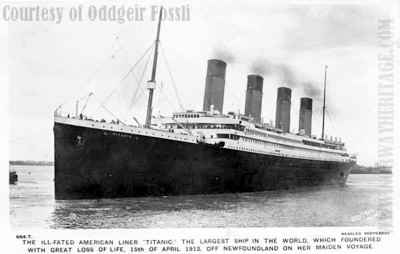
The Titanic

My grandmother spoke of this story several times during my visits and each telling, without variation, left a mysterious impression upon my imagination. The loss of those 1,517 passengers and crew may have changed the course of history in many ways we'll never understand.

-GK3

[Image Credit: Arora Borealis - The Martin Project]
[Image Credit: RMS Titanic Postcard - Courtesy of Norway Heritage - image source]

Antique Radio
[History of Radio - Wikipedia]

Wednesday, May 6, 2009

The Lafayette Escadrille...

Rickenbacker, WWI American AceWith a light breeze, fluffy cumulus clouds drifted by his cockpit window high up in the family barn. As he sailed his Spad in and out of the open loft, young George Keegan's imagination raced with stories of the Lafayette Escadrille's courageous missions against the deadly German Air Force.

Brave young Americans volunteered by the score to fly with the Escadrille, founded by Americans in France during the Great War. Fearless and reckless, the Americans turned the tables on the German flyers and established a bold reputation.

Every week, young George read stories of Eddie Rickenbacker and other famous Aces and imagined himself flying with them hunting the most dangerous of Germans in the skies over France. Mastering loop de loops, barrel rolls, strafing runs and emergency landings became his dreamy obsession. He spent endless hours re-enacting heroic dogfights and aerobatic maneuvers with all his favorite planes and aces.

Stories of the Lafayette Escadrille and it's most famous aviators left an indelible impression on my father's young imagination. He shared stories of these daring pilots with me throughout my childhood and taught me all their aerobatic tricks and heroic tales. He affectionately referred to my friends and I as the "Lafayette Escadrille" throughout my life. This especially applied to my closest friends (you know who you are!) and the Grenadiers from Culver.

My father's love of aviation was definitely borne from the remarkable stories of these brave American flyboys who pioneered combat avaition in the skies over Europe during the Great War.

-GK3

[image credits: Rickenbacker: American Ace of Aces by Stan Stokes website]

Monday, May 4, 2009

Irish Discovery...

Slane Castle, Ireland
Slane Castle [Image Credit]
While researching my father, I found an article about my grandfather (whom I know little about). Due to their tenuous relationship, my father never spoke of him. He never spoke of his grandparents or how our family came to America as well.

I discovered (while writing this blog) my grandfather, George Keegan, was born in 1885 and was the youngest of five (5) brothers and had four (4) older sisters. His father, Thomas Keegan, was born in 1836 to my great great grandparents... James & Lucy.

James Keegan was born in Slane, County of Meath, Ireland on "Shrove Tuesday" in 1803 and left Ireland in 1826. While there is no clear reason why James left Ireland, I did read... "He also mentioned the visit of George IV to Slane Castle. He said that the failure of the crops in Ireland in 1821 was attributed to that visit, as not having brought a blessing, but a curse upon the land".

When James Keegan sailed to North America from Dublin in 1826, he and a small crew rowed ashore to L'Isle-Verte Canada on the south bank of the St. Lawrence river. They were greeted on the shore by a farmer named Thomas Healy. Healy, taken with James' wit and spirit, invited him to stay. They became fast friends.

Healy advised James "not to go into the cities, but rather go to some section of the country where he could take up a farm and build a house for himself."

James eventually made his way to Van Buren, Maine, and in 1827 bought a farm and built a house where he met Lucy and began our family. Together, they raised ten (10) children... five (5) boys and (5) girls.

My eternal thanks to Google's massive book scanning endeavor. Had they not scanned the Historical Archives from Maine, my discovery of our family's Irish heritage (while creating this blog) would not have happened.

Cheers, -GK3

Friday, May 1, 2009

A chance encounter?

Leonardo Da Vinci, Self PortraitAt the age of three (3), my father had an experience that nearly defies augury. One evening, while his parents were entertaining guests, he couldn't sleep and found himself drawn downstairs to an open window in the family library. A cool breeze was bringing sweet scents of a northern Maine summer evening when he saw something that filled him with wonder.

The adults were having a lively discussion in the kitchen and the sound of clanking china and silverware filled the air in the far end of the house. None of them were aware little George was downstairs and not fast asleep in his bed. The sounds of the dinner party seemed to fade as his attention was drawn to the tall figure gently floating in front of the open window.

The summer of 1924 would hold a inexplicable secret for even the brightest of young minds. As the tall figure draped in white robes and long wavy beard hovered for what seemed an eternity, young George's heart filled with calm. He somehow knew the ethereal figure was there to reassure he'd never be alone.

Many of the stories my father, George Keegan Jr., told me about his life bring me back to this dream-like event from his very early childhood. I was never sure if he shared this encounter with anyone. Perhaps his mother knew, but she never spoke of it. He only spoke of it once to me. When he did, I could see visible relief on his face. He probably held this experience close for much of his life.

-GK3

[Image Credits: Leonardo Da Vinci - Self Portrait SOURCE]

Thursday, April 30, 2009

Born on the 4th of July

Washington Monument, 4th of July Fireworks Wikipedia [IMAGE CREDITS]
Arriving two (2) months early, George Keegan Jr. entered this world on the 4th of July... 1921. From the beginning, my father was a fighter. Being born prematurely, the odds were stacked against him in 1921. He or his mother seemed determined he'd enter the world on such a special day.

My grandmother, Ming, was a force of nature. Strong willed, focused and resourceful, she nurtured him and made him strong. However, his skin was always susceptable to sun and he was allergic to milk and onions, keeping him on his toes the rest of his life.

My father always had great purpose, even when he was growing up. I think this was due to his mother's inner strength which was a guiding light throughout his life.

Being born on the 4th of July was a special part of his patriotic nature. In some spiritual way it seemed to carry him through much of his journey.

-GK3

Footnote of the Great War

Every family is changed in some way by war, especially if they have loved ones serving in or exposed to the horrors of the conflict.

My grandmother, Ming, lost her brother on the last day of the war. Only hours after the armistice was signed, her brother was in a phone booth somewhere in France trying to contact family and was killed by a German sniper.

She kept her brother close to her heart and always told happy stories of him up until her late 90's. I think of him often and wish I knew more of his life. He remains an enigmatic character to me still.

'Good night sweet prince; And flights of angels sing thee to thy rest.' - [Hamlet by William Shakespeare]

British Telecom by Stephen Waterfall
"British Telecom - Everywhere" copyright © by Stephen Waterfall - with permission [IMAGE SOURCE]

Ming and the Irishman

Photobucket[IMAGE CREDIT]
Phantom of the OperaBeatrice, a nanny for the Rockefellers, spent much of her childhood in a convent where she grew her sharp mind, spirit and charm. She developed a love for Shakespeare while growing up in this mysterious world, a love that stayed with her through the whole of her life. Born to a french family, The Martins of New Brunswick, Catholic faith was central in her life. Her education was very much a classical education and certainly led to her introduction to the Rockefellers.

What struck me as a young man was how beautiful she was in her youth. Though naive about the mysteries of life, she was armed with amazing wit and a disarming smile. The stories of her time with the Rockefellers allude me at this point in my life, but I do remember that she loved their children dearly and they thought of her as a daughter. She was a young woman of 18 or 19 at this time but, had wisdom way beyond her years. She also had a love of the arts and accompanied the Rockefellers regularly to the opera and other performances.
Irish Clover
The Rockefellers knew a dynamic and boisterous attorney, an aspiring politician at the time, who was close to turning thirty (30) and still single. This Irishman came from a large family of five (5) brothers and was a 5th generation attorney. (I hear they were an interesting bunch but, like many Irishmen of the time, drank way too much.) The Rockefellers invited him to join them at the opera where he had the good fortune to sit next to the nanny. They had an enchanting time at the opera and certainly bewitched each other.

The opera's main character, Ming, was petite, beautiful and had long flowing hair (almost to the floor) and very much resembled the Rockefeller's nanny who, at the time, was still known as Beatrice. The handsome Irishman was so taken with her resemblance to the character on stage that he dubbed her "Ming". From that evening and through the rest of her very long life my grandmother, Beatrice, was known as Ming.

The Irishman, my grandfather George, quickly proposed to the charming nanny and married her shortly thereafter. All in all, it must have been an interesting time. The world had emerged from a long war and the worst pandemic in history, America was on the brink of the "roaring twenties" and hope was tangible everywhere.
George J. Keegan Sr.

Maine Historical Society - Google Books [IMAGE CREDIT]